

Termite Control Services in Gurgaon
Termisect provides termite control services in Gurgaon for apartments, builder floors, villas, offices, warehouses and buildings still under construction. Every job starts with an inspection. We then treat the building using the method set out in IS 6313, the Indian Standard for anti-termite work, and back it with a 1-year or 2-year plan that includes follow-up audit visits.
We are based in Sushant Lok-1, Gurugram, and our business has been in agrochemicals since 1984. We manufacture the pest control formulations our technicians apply. That background shapes how we work: before anyone drills a hole, we tell you which chemical we are using, why, and how it will be applied.
Book a Free Termite Inspection with Termisect Hygiene Solutions
Termite treatment in Gurgaon at a glance
| Question | Short answer |
|---|---|
| What does it cost? | Termite control starts from ₹3,599. The final price depends on area, how far the infestation has spread and the plan you choose, so we quote after inspecting. |
| My building already exists. Which treatment? | Post-construction treatment: drilling at the floor–wall junction and other entry points, injecting termiticide, treating affected woodwork, then sealing the holes. |
| I am building. Which treatment? | Pre-construction soil treatment during foundation and plinth work, following IS 6313 Part 2. |
| Do I need to move out? | Usually not, for injection-based treatment. We tell you which rooms to keep clear, and for how long, before we start. |
| Is there a warranty? | Yes, with our 1-year and 2-year plans. Both include audit visits. |
| How soon will it work? | Activity typically falls over the following weeks. The treatment takes about 21 days to reach full effect, and we check results at the scheduled audit. |
Signs of termite infestation in Gurgaon homes and offices
Most termite damage to buildings in this region is done by subterranean termites. They nest in soil and enter buildings through cracks, joints and service pipes. They avoid light and dry air, so you rarely see the insects. You see what they leave behind.
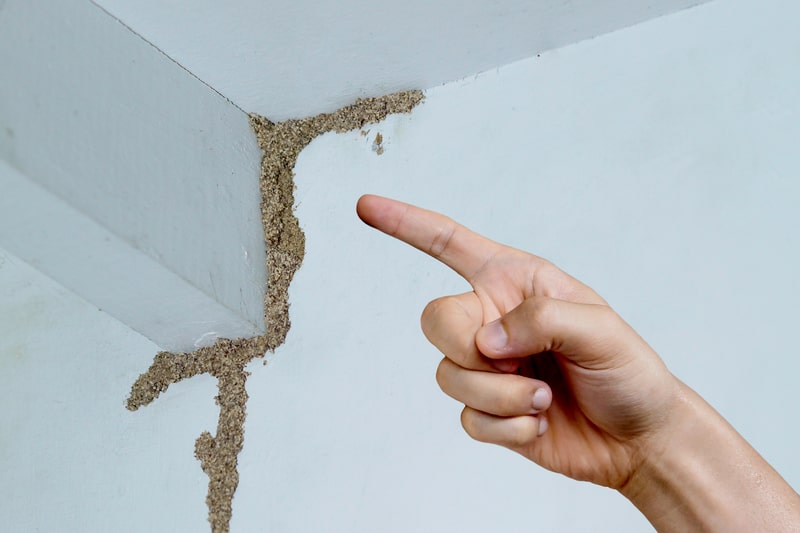
Look for:
- Mud tubes: thin, pencil-width earthen tunnels running up walls, along skirting, inside cupboards or around door frames.
- Hollow-sounding wood: door frames, skirting or wardrobe bases that sound papery when tapped, or give way when pressed with a screwdriver.
- Damage that starts low: swelling, crumbling or blistered paint at the base of door frames and fitted furniture, especially near bathrooms and kitchens.
- Wings on sills: discarded wings near windows and lights after a monsoon shower. Winged termites come from a mature colony nearby.
- Soil where it should not be: fine mud lines in tile joints, behind switchboards or along the edges of marble flooring.
- Chewed cartons and files: stored boxes, paper or books damaged from below, often the first sign in storerooms and warehouses.
Subterranean termites do not leave piles of pellets. Small, hard, sand-like pellets under furniture point to drywood termites or wood borers, which need a different approach. An inspection settles which one you have.
Why upper-floor flats are not immune
Living on the twelfth floor does not rule out termites. The Indian Standard for existing buildings records cases where termites appeared on upper floors while lower floors looked clean, because they had travelled through lift wells, cable casings and utility pipes (IS 6313 Part 3). In a Gurgaon high-rise society, that makes a single infested flat a warning about the shaft. A proper inspection checks ducts, shared walls and electrical conduits, not just your furniture.
Why termites keep turning up in Gurgaon buildings
Three conditions make buildings in Gurgaon vulnerable.
Moisture here is usually local. Gurgaon's groundwater is heavily over-drawn. In 2025 the Central Ground Water Board told the National Green Tribunal that Gurugram Urban extracts more than three times what is recharged (Down To Earth). So the damp that termites need indoors usually comes from the building itself: a leaking bathroom pipe, an AC drain line, a balcony planter, or monsoon seepage through an outer wall. Fixing that source is part of lasting control.
The monsoon starts new colonies. Winged termites leave a mature colony to found new ones, and this swarming can happen at any point in the monsoon or post-monsoon period (IS 6313 Part 3). Swarmers indoors after rain mean a colony is close by.
Construction keeps disturbing the ground. New plumbing lines, re-laid floors, modular kitchens and fresh wooden fixtures can open paths through soil that was once treated, or put untreated wood straight against a damp wall.
The termites themselves are well documented locally. Surveys around Delhi have recorded subterranean genera including Odontotermes, Microtermes and Coptotermes (Thakur, 2007), and Heterotermes indicola, one of the main building pests in India, has also been reported from the Delhi region (Mahapatro & Kumar, 2013).
Our termite control services in Gurgaon
We offer six services, and most jobs combine two or three of them.
Termite inspection and infestation assessment
A technician checks the places termites use first: floor–wall junctions, door and window frames, bathrooms, kitchens, wardrobes, switchboards and electrical conduits, and, in independent houses, the outer walls and any soil or garden beds touching them. You get a clear account of where activity is, how it is likely getting in, which moisture sources are feeding it, and what treatment we recommend. The quote comes after this, not before.
Post-construction termite treatment
For homes and offices that already have termites, or want protection after missing pre-construction treatment. We create a treated zone in the soil under and around the building by injecting termiticide through drilled holes, treat affected woodwork, and seal every hole. The steps are set out below.
Pre-construction anti-termite treatment in Gurgaon
For builders, contractors, architects and owners building a new home. The soil is treated in stages as foundations and plinth go in, so a continuous chemical barrier sits between the ground and the building, as IS 6313 Part 2 describes (BIS code). Treatment is timed to your construction schedule and is not done on rain-soaked soil.
Residential termite treatment
For flats in high-rise societies, builder floors, independent houses and villas. Treatment is planned around your household: which rooms are done first, what needs to be moved from wardrobes and kitchen cabinets, and when areas can be used again.
Commercial termite control
For offices, co-working spaces, retail stores, restaurants, warehouses and other commercial property. Commercial termite pest control in Gurgaon often means working around false ceilings, cable trays, modular furniture and stored stock. We can treat outside your operating hours to avoid disruption, and provide written service records for your facility files.
Preventive protection and follow-up
Our 1-year and 2-year plans include scheduled audit visits after the first treatment, so new activity is caught early rather than discovered in a damaged wardrobe a year later.
Book a Free Termite Inspection
How termite treatment in Gurgaon works for an existing building
Post-construction treatment follows the approach in IS 6313 Part 3, the Indian Standard for treating existing buildings (BIS code). The aim is simple: kill the termites already inside, then make the soil under the floor and around the walls lethal to any that try to come back.
- Inspect and map. We find the extent of the infestation and the routes termites are using to enter from the soil.
- Clear active galleries. Mud tubes are removed, so any fresh activity later is easy to spot.
- Drill at entry points. Holes are drilled at skirting level along the floor–wall junction, and at cracks, construction and expansion joints, wall corners and where door frames meet the floor. The standard places these at roughly 300 mm intervals, deep enough to reach the soil below. Our holes are about 1.8 cm in diameter, drilled about 1 ft (300 mm) apart.
- Inject the termiticide. A diluted termiticide is pumped into each hole until it stops taking liquid, soaking the soil beneath the floor and the masonry at plinth level.
- Treat the woodwork. Infested frames and fixtures in contact with floors or walls are treated through small drilled holes. Wood damaged beyond repair should be replaced, and the new timber treated before it goes in.
- Treat the outside, where accessible. In independent houses and villas, the soil along the external walls is treated too, or treated through holes drilled in the concrete apron.
- Seal and finish. Every hole is sealed with white cement and finished to blend with the surface.
- Audit. We return at month 4, and again at month 13 on the 2-year plan, to check for new activity and re-treat where needed.
Most flats take a few hours. Larger homes and commercial sites take longer. You can read more about how our termite treatment process works.
Pre-construction vs post-construction termite treatment
Pre-construction treatment protects the soil before the building covers it. Post-construction treatment reaches that same soil later, through the floor and walls. If you are building, pre-construction treatment is the easier and more complete option, because every trench and plinth surface is still open.
| Pre-construction treatment | Post-construction treatment | |
|---|---|---|
| When | During foundation, plinth and flooring work | Any time after the building is complete |
| Indian Standard | IS 6313 Part 2 | IS 6313 Part 3 |
| What is treated | Foundation pits and trenches, plinth fill, soil along the outer walls, around pipes and conduits, expansion joints | Soil under floors via drilled holes, masonry at plinth level, outer perimeter where reachable, infested woodwork |
| Drilling needed | No | Yes, sealed afterwards |
| Best for | New construction and full redevelopment | Existing homes, offices and warehouses, with or without active termites |
| Main limit | The barrier must not be disturbed later by digging or plumbing work | Coverage depends on how much of the floor and perimeter can be reached |
Both treatments target subterranean termites. Neither protects against drywood termites living inside furniture, which need the wood itself treated.
Which termite treatment suits your property?
| Your situation | What usually fits |
|---|---|
| Flat in a high-rise, termites in a wardrobe or kitchen | Post-construction treatment inside the flat, plus a check of ducts and shared walls. If the shaft is involved, your society's maintenance team should know. |
| Ground-floor builder floor or independent house | Post-construction treatment inside, plus soil treatment along the outer walls |
| Villa with garden, planters or wooden decking | Post-construction and perimeter treatment, and moving wood, mulch and planters away from the walls |
| Renovating: new flooring or modular kitchen | Treat while the floor is open and before new woodwork is fitted |
| New construction or redevelopment | Pre-construction treatment under IS 6313 Part 2, starting at excavation |
| Office with modular furniture and false ceilings | Post-construction treatment at floor–wall junctions, with checks of cable trays, partitions and the false ceiling |
| Warehouse or retail store | Floor-joint and perimeter treatment, inspection of pallets and cartons, and stock kept off walls and floors |
Termite treatment cost in Gurgaon
Termisect's termite control starts from ₹3,599. That is a starting point, not a quote. Two flats of the same size can need very different work, which is why we price after inspection.
What moves the price:
- Area treated: the whole home or only the affected rooms, and the length of floor–wall junction to be drilled.
- How far it has spread: one door frame, or several walls, floors and fitted units.
- Flooring and finish: marble, wooden and large-format tiled floors need slower drilling and careful finishing.
- Woodwork: the number of wardrobes, panels, frames and kitchen units to treat.
- Outside access: independent houses and villas often need perimeter soil treatment as well.
- Plan length: the 2-year plan adds an audit visit and a longer warranty.
- For new builds: plinth area and the number of construction stages to be treated.
Whatever company you choose, a fair quote should state in writing the areas to be treated, the active ingredient and its dilution, the number of visits, the warranty period and its conditions, and what is not included, such as replacing damaged wood or repainting. If one quote is far below the others, ask whether it covers soil treatment or only a spray on the visible damage.
Request a Termite Inspection and Quote
Is termite treatment safe for children and pets?
Termiticides are poisons, and the honest answer is that safety comes from how they are applied. The Indian Standard classes anti-termite chemicals as hazardous, notes that skin contact with the concentrate is the most likely route of accidental poisoning, and says they must be kept away from children, pets and drinking-water sources (IS 6313 Part 3, Annex C).
Post-construction treatment keeps exposure low because the chemical goes into holes that reach soil below the floor, and those holes are then sealed. Our technicians mix and handle concentrates themselves, wear protective equipment, and take containers away when they leave.
What we ask of you:
- Keep children and pets away from the area while the team drills and injects. Once the holes are sealed, the room can be used again.
- Move pet bowls, toys, food and open utensils out of treatment areas, and cover aquariums.
- Tell us beforehand if anyone at home is pregnant, has asthma, or if there is an infant in the house.
- Ask us for the label and safety data sheet of the product we use if you want to check it yourself.
Our formulations are odourless, and for injection-based treatment families do not need to move out.
How long termite treatment lasts, and what the warranty covers
No one can honestly promise a fixed number of years, because the treated soil does not stay untouched. Field trials show the range. In Thailand, several termiticides, including bifenthrin, fipronil, imidacloprid and chlorpyrifos, kept termites out of test plots for seven years or more, while other formulations of the same chemicals failed within two to six years, with results varying by soil and rainfall (Samerjai et al., 2016). The US Forest Service uses five years without termite penetration in its test plots as the benchmark for a soil termiticide (Wagner, 2003).
In a real home, the barrier is usually broken long before the chemical runs out: a plumber digs a trench, a floor is re-laid, new woodwork goes against a damp wall, or a leak keeps one corner wet. That is why our plans pair treatment with audit visits, and why we ask you to tell us before renovation work.
| Plan feature | 1-year plan | 2-year plan |
|---|---|---|
| Site evaluation and risk review | Yes | Yes |
| First service | Month 1, two-person team | Month 1, two-person team |
| Audit visits | Month 4 | Months 4 and 13 |
| Aftercare and prevention advice | Yes | Yes |
| Warranty | 1 year | 2 years |
If termite activity returns in a treated area during the warranty period, we come back and re-treat it at no extra cost. Warranty documentation is issued with every plan.
Why Termisect for termite control in Gurgaon
- We make what we apply. Our business has been in agrochemicals since 1984, and we manufacture the public health formulations our technicians use. They therefore know the composition, dilution and label requirements of what goes into your walls, and can explain them in plain terms. Read more about Termisect's background in manufacturing pest control formulations.
- Inspection before price. You see what we found before you see a number.
- A recognised method. Post-construction and pre-construction work follow the approach in IS 6313.
- Follow-up built in. Every plan includes scheduled audits, not just a phone number to call.
- Local and reachable. Our office is at G-212, Sushant Shopping Arcade, Sushant Lok-1, and we take calls from 8:00 AM to 10:00 PM, seven days a week.
We serve homes and businesses across Gurugram, in every sector, including the DLF phases, Golf Course Road, Golf Course Extension Road, Sohna Road, Dwarka Expressway and Manesar.
How to keep termites away after treatment
- Fix leaks in bathrooms, kitchens and AC drain lines quickly, and check for damp patches after the monsoon.
- Keep planters, garden soil and mulch off external walls, and use raised stands on balconies.
- Store cartons, files and old furniture on racks, away from walls and off the floor.
- Leave a small gap behind wardrobes and check their bases twice a year.
- Tell your termite provider before digging, plumbing or flooring work, since it can break the treated zone.
- If you spot mud tubes, photograph them and leave them for the inspector instead of spraying a store-bought insecticide. The tubes show where termites are entering.
Damp areas that attract termites also attract cockroaches and other pests. If you are dealing with those too, see our other pest control services in Gurgaon.
How to choose the best termite control in Gurgaon
The best provider for your building is the one that can show its work. Before you book any company, including us, check that it:
- Holds a pest control operator licence. Commercial pest control in India is regulated under the Insecticides Act, 1968 and the Insecticides Rules, 1971 (Insecticides Rules). Ask to see it. Termisect's licence number is INSCTLIC/2026/00270.
- Inspects before quoting for anything more than a single spot.
- Names the active ingredient and its dilution, and uses a product meant for termite control in buildings.
- Explains its method and how it matches IS 6313.
- Gives a written warranty with an audit schedule and clear exclusions.
- Tells you how to prepare, and when treated rooms can be used again.
Treat “lifetime protection” and “100% safe” claims with caution. Neither fits what the evidence shows.
Frequently asked questions about termite control in Gurgaon
How much does termite treatment cost in Gurgaon?
Termisect's termite treatment starts from ₹3,599. The final cost depends on the area treated, how far the infestation has spread, the flooring, the amount of woodwork, outside access, and whether you choose a 1-year or 2-year plan. We give an exact quote after inspection.
What are the signs of termite infestation?
The clearest sign is mud tubes: thin earthen tunnels on walls, skirting, door frames or inside cupboards. Others include hollow-sounding wood, damage at the base of door frames and fitted furniture, discarded wings near windows after rain, mud lines in tile joints, and chewed cartons in storage.
Which termite treatment is suitable for an existing house?
Post-construction treatment under IS 6313 Part 3. Holes are drilled along the floor–wall junction and at other entry points, termiticide is injected to treat the soil below, infested woodwork is treated, and the holes are sealed. Independent houses usually also need treatment of the soil along their outer walls.
What is the difference between pre-construction and post-construction termite treatment?
Pre-construction treatment (IS 6313 Part 2) treats the soil in stages while foundations and plinth are built, forming a barrier before the building covers it. Post-construction treatment (IS 6313 Part 3) reaches that soil later by drilling through floors and walls in a finished building.
How long can termite treatment remain effective?
It varies. Field trials have recorded seven years or more for some termiticides, and failures within two to six years for others, depending on formulation, soil and rainfall. In homes, plumbing work, re-flooring and leaks often shorten protection, which is why our plans include audit visits within a 1-year or 2-year warranty.
Is termite treatment safe for children and pets?
It can be done safely when the chemical is injected below floor level and the holes are sealed, which keeps it out of reach. Our formulations are odourless and families can stay at home; children and pets should simply stay away from the area while the team drills and injects. Termiticides are poisons, so any company calling them completely harmless is overstating it.
Is a warranty available for termite treatment?
Yes. Our 1-year plan includes an audit at month 4 and a 1-year warranty. Our 2-year plan includes audits at months 4 and 13 and a 2-year warranty.
Do I need to vacate my home during termite treatment?
For injection-based post-construction treatment, usually not. You will need to keep the rooms being treated clear while the team works.
How long does the treatment take?
Most flats are done in a few hours. Larger homes, villas and commercial premises take longer, and we confirm the time after inspection.
Will drilling damage my marble or tiled floor?
Holes are drilled at the floor–wall junction and sealed with white cement afterwards to blend in. Some patching may still be visible on certain stones or colours, and we discuss this before starting.
Can I treat termites myself?
Spraying visible termites kills only the workers you can see. The colony lives in the soil, and reaching it means treating the soil under the floor, which needs drilling equipment and licensed handling of termiticides.
Book a termite inspection in Gurgaon
If you have seen mud tubes, hollow wood or swarmers, or you are about to start construction, the first step is an inspection. A Termisect technician will find where termites are entering, explain what they found, and recommend the treatment that fits your building.
Book a Free Termite Inspection with Termisect Hygiene Solutions
Call +91 96673 86387 or +91 96673 85386, or email contact@termisect.com. We are available 8:00 AM to 10:00 PM, seven days a week.